Spring Boot Microservices: A Production Architecture Guide

Spring Boot is the default way to build microservices on the JVM, and for good reason — autoconfiguration, a vast ecosystem, and production-ready defaults. But the framework won't save you from the hard part: drawing the right boundaries and operating many services well. This guide covers the architecture decisions that actually determine whether a microservices system succeeds.
Start with boundaries, not services
The most expensive mistake in microservices is splitting by technical layer or splitting too early. A good service boundary follows a business capability — "ordering", "inventory", "billing" — not "the controller tier" or "the database tier". Each service should own its data and expose it only through its API. The moment two services share a database table, you have a distributed monolith: all the operational cost of microservices with none of the independence.
A useful test: can this service be deployed, scaled, and rolled back without coordinating with another team? If not, the boundary is wrong.
Communication: sync where you must, async where you can
Services talk in two ways, and choosing well is half the battle:
- Synchronous (REST/gRPC) for queries that need an immediate answer — "is this item in stock right now?". Keep these chains short; every hop adds latency and a failure point.
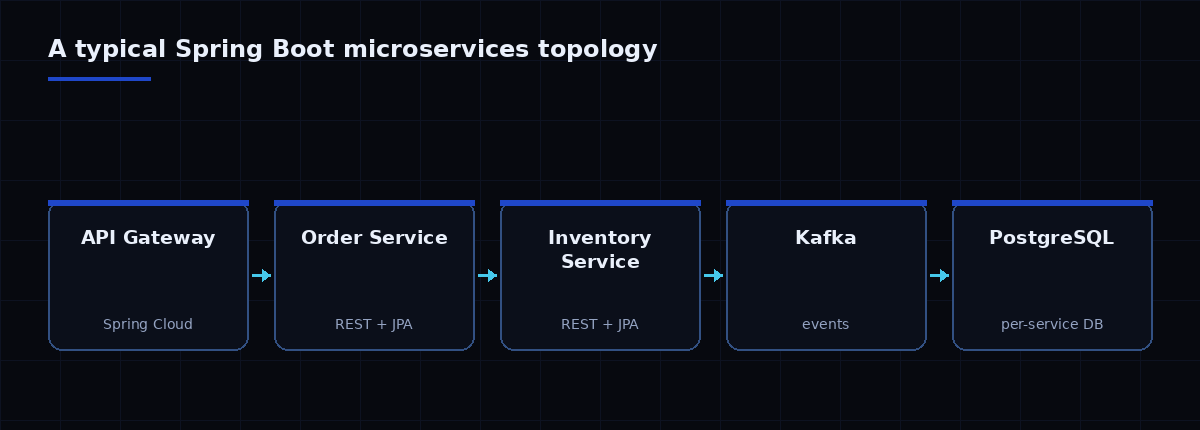
- Asynchronous (events via Kafka) for anything that can happen eventually — "an order was placed, react however you need". This is what keeps services decoupled and independently resilient.
An API gateway (Spring Cloud Gateway) sits in front, handling routing, authentication, and rate limiting so individual services don't each reimplement them.
Resilience is not optional
In a monolith, a method call either returns or throws. In a distributed system, it can also hang forever — and a hung call holds a thread, which exhausts the pool, which cascades. Build in resilience from day one with Resilience4j:
@CircuitBreaker(name = "inventory", fallbackMethod = "fromCache")
@TimeLimiter(name = "inventory")
public CompletableFuture<Stock> check(String sku) {
  return inventoryClient.getStock(sku);
}

private CompletableFuture<Stock> fromCache(String sku, Throwable t) {
  return CompletableFuture.completedFuture(cache.lastKnown(sku));
}
Timeouts, circuit breakers, retries with backoff, and bulkheads turn a downstream failure from an outage into a degraded-but-working experience.
Observability: you can't operate what you can't see
With many services, a single user request crosses several processes. Three pillars make that debuggable:
- Distributed tracing (Micrometer Tracing + OpenTelemetry) to follow one request across services.
- Structured logs with a correlation ID on every line.
- Metrics (Micrometer + Prometheus) for latency, error rates, and saturation per service.
Spring Boot Actuator exposes health and metrics endpoints out of the box — wire them into your platform before you ship, not after the first incident.
The mistakes that sink teams
- Too many services, too soon. Start with a modular monolith and extract services as boundaries prove themselves.
- Shared databases. The fastest route back to a monolith.
- No automation. Ten services means ten pipelines; without CI/CD and infrastructure-as-code, operations collapse.
- Ignoring data consistency. Distributed transactions are hard — use sagas and the outbox pattern instead of two-phase commit.
Key takeaways
- Split by business capability; let each service own its data.
- Prefer async events for decoupling; keep synchronous chains short and resilient.
- Build in circuit breakers, timeouts, and tracing before you have ten services to debug.
We design and build Spring Boot microservices for enterprises end to end. Explore our event-driven microservices and Java backend development services, or talk to an architect.
Related articles
Building Intelligent Java Apps with Spring AI and OpenAI
Spring AI brings LLMs into the Spring ecosystem with the same abstractions Java teams already know. Here's how to wire up chat, prompts, and retrieval-augmented generation in a real Spring Boot service.

Event-Driven Architecture with Apache Kafka and Spring Boot
Event-driven architecture decouples services and lets them scale independently — but only if you get topics, idempotency, and ordering right. A practical field guide with Spring Boot.