Legacy Java Modernization: From Java 8 to Java 21
A huge share of enterprise Java still runs on Java 8, released in 2014. It works — but it's well past free public support, misses years of performance and security improvements, and makes it harder to hire and retain engineers. Modernising to the Java 21 LTS is one of the highest-return, lowest-glamour investments a Java shop can make. The key is to do it incrementally, not as a risky rewrite.
Why bother upgrading
- Performance for free. Modern JVMs and garbage collectors (G1, ZGC) cut latency and memory use with no code changes.
- Security and support. Newer LTS releases get active patches; Java 8 increasingly does not.
- Developer productivity. Records, sealed types, pattern matching, and text blocks remove mountains of boilerplate.
- Virtual threads (Java 21). Massive concurrency for I/O-bound services with simple, blocking-style code.
Step 1 — Assess before you touch anything
Inventory what you're standing on: the JDK version, build tool, and every dependency. The biggest upgrade blockers are old libraries and the removal of internal APIs and Java EE modules (JAXB, JAX-WS) from the JDK. Run jdeps to find use of internal/removed APIs, and audit dependencies for versions that support modern Java. This assessment tells you the real size of the job.
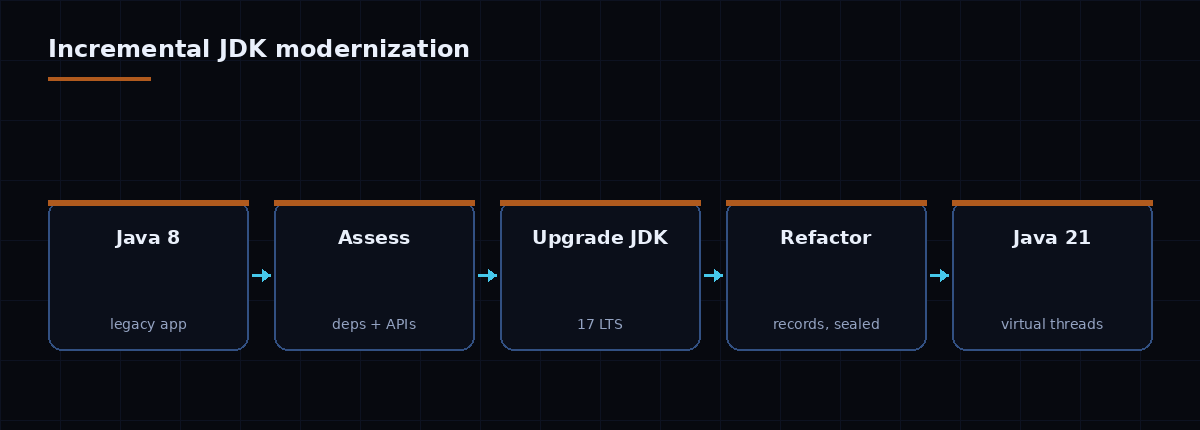
Step 2 — Upgrade in LTS hops
Don't jump straight from 8 to 21. Move in supported LTS steps — 8 → 17 → 21 — building and running the full test suite at each stop. Each hop surfaces a manageable set of issues rather than one overwhelming pile. Common fixes along the way:
- Add explicit dependencies for the removed Java EE modules.
- Update build plugins and frameworks (e.g. a modern Spring Boot, which itself requires a recent JDK).
- Replace deprecated and removed APIs flagged by the compiler.
Step 3 — Adopt modern language features
Once you're on a modern JDK, refactoring pays compounding dividends in readability. The classic example: a verbose Java 8 data class becomes a one-line record.
// Java 8
public final class Money {
  private final long amount; private final String currency;
  // constructor, getters, equals, hashCode, toString ... 30+ lines
}

// Java 17+
public record Money(long amount, String currency) {}
Sealed types make domain models exhaustive and safe; pattern matching simplifies branching; text blocks tidy SQL and JSON. Apply them as you touch code — you don't need a separate refactoring project.
Step 4 — Exploit virtual threads
Java 21's virtual threads let a service handle hundreds of thousands of concurrent blocking operations cheaply. For I/O-bound applications — most web backends — this can dramatically raise throughput while you keep writing simple, synchronous code instead of tangled reactive chains. It's often the single most compelling reason to reach 21.
Key takeaways
- Java 8 is a liability — modernising to the Java 21 LTS improves performance, security, and hiring.
- Assess dependencies and removed APIs first, then upgrade in LTS hops (8 → 17 → 21) with tests at each step.
- Adopt records, sealed types, and virtual threads incrementally as you touch the code.
We modernise legacy Java systems without halting delivery — that's the whole point of our legacy Java modernisation service, sequenced route by route with a rollback at every phase. See the legacy scenarios we handle or talk to an architect about your upgrade.
Related articles

Building Intelligent Java Apps with Spring AI and OpenAI
Spring AI brings LLMs into the Spring ecosystem with the same abstractions Java teams already know. Here's how to wire up chat, prompts, and retrieval-augmented generation in a real Spring Boot service.

Event-Driven Architecture with Apache Kafka and Spring Boot
Event-driven architecture decouples services and lets them scale independently — but only if you get topics, idempotency, and ordering right. A practical field guide with Spring Boot.